


Yantra Yoga is a highly evolved method of movement and breathing that has been preserved in its original and unadulterated form since the eight century, when it was first brought to tibet by Padmasambhava, the great and legendary master who introduced buddhism to that vast and remote kingdom. He is said to have received the instructions from the mahasiddha Humkara, a guru he had encountered in Nepal during extensve travelsfrom the land of Oddiyana throughout the Himalayan region.
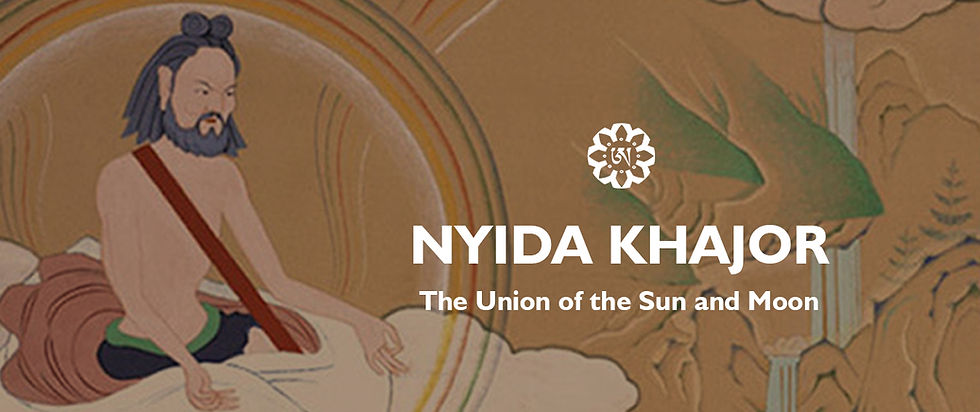
Later,when Padmasambhava went to Tibet, he transmitted the principles of Yantra Yoga to the scholar , master, and translator Vairochana, who in turn recorded the oral instructions in a text called Nyida Khajor in Tibetan, The Union of the Sun and Moon.This short and concise text is the oldest known document relating to yoga in the Buddhist Tradition. It includes a brief description of seventy-five positions similar to those of Hatha Yoga in form, but diferent in the dynamics of the way in which they are practiced, and specially in the coordinations of movement and breathing. What is particularly remarkable about the Union of the Sun and Moon, however, is that it provides instructions on eighteen preliminary exercises, divided into three groups, that are entirely unlike any taught in Indian systems. We can only speculate where these instructions originated. But one thing we know for sure, and can recognize experientially, is that these three groups of exercises are thighly linked with the main practice. Their purposes are to warm up the body; train the different aspects of the breathing, in particular the holds; and open the energy channels. It is also interesting to note that the word hatha is composed of the two syllables Ha and Tha, meaning “sun” and “moon” in traditional Sankrit etymology, while the Sanskrit Term yoga is commonly translated as “union.” So in effect, Nyida (sun and moon) Khajor (union) emboies the same metaphor as Hatha Yoga.
In Buddhist and Hindu traditions, those two celestial bodies, so influential for planet earth, symbolize the feminine and masculine aspects of our subtle bodies, and in cultures all over the world they are associated with the male and female principles. In this context, one of the distinguising characteristics of yantra Yoga is that its aymetrical poses start on alternate sides for men and women. This is because it draws on the theory that the solar and lunar energies flow on opposite sides in each gender. The reversal is a means to enhance and balance the qualities naturally present in each of us.

Another eymological clue about the underlying principle of the practice is supplied by the Sankrit term yantra. It literally means “instrument” or “machine”, but commonly refers to a geometric figure whose shape is considered a suitable instrument or medium to provoke a meditative experience. In the context of Yantra Yoga, it mainly refers to the movement of the body; Yantra Yoga is a vehicle that uses movement to deepen our knowledge of our real nature. In fact, while the Sanskrit term yoga means “union”, the Tibetan translation of the term, naljor, more specifically refers to possessing the real knowledge.Yantra Yoga, for centuries a closely guarded secret reserved for advanced yogic practitioners, was first introduced to the Wes in the 1970 by one of the foremost Dzogchen masters of our time, Chögyal Namkhai Norbu. He received these teachings in Tibet at a young age from his uncle Togden Ugyen Tendzin (1888-1962) and received further clarification from other omtemporary masters. To preserve this knowledge, Chögyal Namkhai Norbu wrote a commentary on Vairochana’ s original text that has since been published in numerous languages. Thanks to Chögyal Namkhai Norbu, the lineage of Yantra Yoga remains unbroken, and we have access thoughout the world to the vast and profound knowledge of this system and to the principles underlying the art of practicing it correctly. His decision to make it openly available was a direct response to the exigency of our times.